Hi, Friends! You know that feeling when you're having a terrible Monday and time just drags on forever?
Well, near a black hole, that's not a mood, it's literally physics. Time actually slows down the closer you get to one of these cosmic monsters, and no, you don't need a time machine to prove it.
Einstein figured this out a long time ago, and scientists are still finding new ways to have their minds blown by it.
What Even Is a Black Hole?
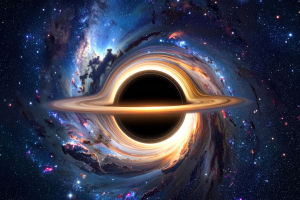
Think of a black hole as the universe's most dramatic overachiever. It's a region in space where gravity is so insanely strong that nothing, not light, not matter, not your hopes and dreams, can escape once it crosses a boundary called the event horizon.
Black holes form when massive stars collapse under their own gravity at the end of their lives. The result is an object so dense that it warps space and time around it like a bowling ball sitting on a trampoline, except the trampoline is the fabric of the universe and the bowling ball weighs more than the Sun.
Gravity Is the Real Time Thief
Here's where things get wonderfully weird. According to Einstein's general theory of relativity, gravity doesn't just pull on objects; it actually bends time itself. The stronger the gravitational field, the slower time passes.
This is called gravitational time dilation, and it's not just a theory sitting in a textbook collecting dust. It's been measured and confirmed in real life. Even here on Earth, clocks on GPS satellites run slightly faster than clocks on the ground because they're farther from Earth's gravitational pull. Scientists have to correct for this difference, your navigation app would send you into a lake.
Now take that concept and crank it up to cosmic levels. Near a black hole, gravity is so extreme that time slows to a crawl compared to what a distant observer would experience. If you could hover just outside the event horizon of a black hole, time for you would tick incredibly slowly, while billions of years might zip by for someone watching from a safe distance. You'd basically be the ultimate procrastinator, doing nothing and still outlasting entire civilizations.
The Point of No Return
The event horizon is the boundary where escape becomes impossible. Cross it, and you're not coming back for dinner. According to NASA, as matter falls toward a black hole, it gets stretched and compressed in a process scientists cheerfully call "spaghettification." Yes, that is the real scientific term. You'd be stretched out like cosmic pasta. Not exactly a great Tuesday.
From the perspective of an outside observer, something falling into a black hole would appear to slow down and freeze right at the event horizon, growing dimmer and dimmer as the light it emits gets stretched by gravity. This is gravitational redshift, where light loses energy trying to climb out of a deep gravitational well.
So technically, from far away, you'd never actually see something fall in. It just sort of... fades away dramatically, like a soap opera character exiting stage left.
Why This Actually Matters
This isn't just cool party trivia, though it absolutely is that too. Understanding how black holes warp spacetime helps scientists understand the fundamental nature of the universe. It connects quantum mechanics with general relativity, two theories that currently get along about as well as cats and vacuum cleaners.
Black holes are natural laboratories for testing the limits of physics, and every new observation brings us closer to understanding what space, time, and gravity actually are at the deepest level.
The supermassive black hole at the center of our galaxy, called Sagittarius A*, has been observed and even photographed by the Event Horizon Telescope collaboration. Its gravitational influence is massive, and studying it gives researchers real data about how extreme gravity behaves in practice.
So next time you feel like time is flying by too fast, just remember, you could be parked near a black hole where time stretches like taffy and the universe ages around you while you barely move. Compared to that, your busy week sounds perfectly manageable. Drop a comment if this warped your sense of reality a little, because honestly, that means it worked!