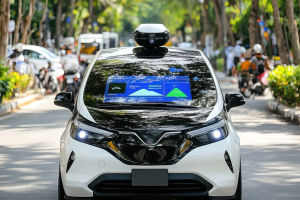
Imagine sitting in a car, relaxing as it effortlessly navigates traffic, makes turns, and even parks itself. That's the promise of self-driving cars, and at the heart of this technology is machine learning.
By teaching cars to learn from data, make decisions, and improve over time, machine learning is transforming the automotive industry and moving us closer to a world where human drivers are no longer necessary.
What is Machine Learning?
Before diving into its role in autonomous vehicles, let's first understand what machine learning is. At its core, machine learning (ML) is a branch of artificial intelligence (AI) that enables systems to learn and improve from experience without being explicitly programmed. Instead of following fixed instructions, ML algorithms use data to identify patterns, make decisions, and predict outcomes.
In the case of self-driving cars, machine learning algorithms can analyze a vehicle's surroundings, make real-time decisions, and improve based on past experiences. Think of it like teaching a child to recognize different objects. Initially, the car may not know the difference between a pedestrian and a street sign. But, over time, it "learns" from thousands of images and sensors, refining its ability to detect and react.
Machine Learning's Role in Perception
One of the key areas where machine learning plays a major role in self-driving cars is perception—the ability to understand and interpret the car's environment. This involves processing data from various sensors such as cameras, LIDAR, and radar to detect objects, lane markings, road signs, and even other vehicles.
For example, consider a scenario where a car is approaching a crosswalk. Machine learning algorithms process data from the car's cameras to recognize the pedestrian standing at the crosswalk. The system then evaluates whether the pedestrian is likely to cross and makes a decision—either to slow down, stop, or continue driving based on the situation. Over time, the car learns from each experience and improves its judgment in similar scenarios.
Decision-Making and Path Planning
Another critical area where machine learning is used in self-driving cars is in decision-making and path planning. Once the car perceives its environment, it needs to figure out how to respond. Should it change lanes? Should it stop at a red light or continue? Should it avoid a collision? These decisions are made in real-time, and ML algorithms are crucial for calculating the best course of action.
For example, when the car approaches an intersection, it needs to decide whether it should yield to other traffic or proceed. Machine learning algorithms help assess the situation by evaluating factors like vehicle speed, position, and the state of traffic signals. The system uses historical data and learned experiences to make these decisions, adjusting its responses based on what it has learned from previous trips.
Training with Data: Supervised vs. Unsupervised Learning
The backbone of machine learning in self-driving cars is the vast amount of data collected from real-world driving experiences. This data is used to train algorithms to make accurate decisions. There are two main types of machine learning used: supervised learning and unsupervised learning.
1. Supervised Learning: In this approach, a human provides labeled data, such as images of pedestrians, vehicles, or traffic signs. The car's system then learns to associate these labels with the corresponding objects. For example, by showing the system thousands of images of pedestrians and labeling them, the system learns to recognize people on the road.
2. Unsupervised Learning: This method doesn't rely on labeled data. Instead, the algorithm analyzes raw data to find patterns and relationships on its own. In the case of self-driving cars, this could involve analyzing road conditions, traffic flow, and weather patterns without the need for human labeling. The car learns to adapt to new and unpredictable situations based on the data it encounters.
Continuous Improvement: Reinforcement Learning
Self-driving cars also use reinforcement learning (RL), a type of machine learning where the system learns through trial and error. In this approach, the car gets feedback from its actions, either positive or negative.
For example, when the car successfully avoids a collision, it receives positive reinforcement, which strengthens the algorithm's decision-making abilities. Conversely, if the car makes an unsafe decision (like not yielding to a pedestrian), it receives negative feedback, prompting the system to adjust its behavior in future encounters.
This continuous cycle of learning and adjusting allows the car's system to improve over time, even in complex or dynamic environments. The more data the system collects, the better it becomes at predicting and reacting to various scenarios.
Challenges and Limitations
While machine learning has brought self-driving cars a long way, there are still significant challenges to overcome. One major issue is ensuring that the algorithms can handle edge cases—rare or unusual situations that the car may not have encountered before.
For example, a self-driving car may struggle with a construction zone or a cyclist behaving unpredictably. While the system can learn over time, there's still the challenge of ensuring the car is capable of handling these edge cases in real time.
Another limitation is the reliance on data. Machine learning algorithms in self-driving cars require massive amounts of high-quality data to function effectively. Without sufficient data, the car may struggle to make accurate decisions, especially in unfamiliar environments or challenging weather conditions.
Looking Ahead: The Future of Machine Learning in Autonomous Driving
The future of self-driving cars is undoubtedly intertwined with machine learning. As algorithms continue to improve, we can expect autonomous vehicles to become even safer, more reliable, and capable of handling an increasing variety of scenarios. The key will be the continued evolution of machine learning techniques, such as reinforcement learning and deep learning, which will allow self-driving cars to make decisions with greater precision.
In the near future, we could see more widespread use of self-driving vehicles in industries like ride-sharing, logistics, and public transportation. As the technology advances and the challenges are addressed, machine learning will play a crucial role in the safe and efficient operation of autonomous vehicles.
Final Thoughts
Machine learning is at the core of the development of autonomous vehicles, allowing them to learn, adapt, and make decisions in real-time. While there are still hurdles to overcome, the progress we've seen so far is promising. As the technology continues to evolve, we're closer than ever to a future where autonomous vehicles are a common part of our daily lives, offering increased safety and convenience on the road.