The world of music is vibrant and constantly changing, but have you ever wondered how instruments came to be?
From the earliest known instruments to the electric guitars we see today, the journey of musical instruments is a story of creativity, innovation, and cultural transformation.
Let's take a deeper dive into this fascinating evolution, tracing the major milestones that helped shape the instruments we use in modern music.
Early Beginnings: The Birth of Sound
Before we had pianos or violins, early humans experimented with their environment to create sound. The first instruments were quite simple, often made from natural materials like wood, reeds, and animal skins.
1. Percussion Instruments
Early humans discovered rhythm by tapping stones, logs, or hollowed-out objects. These rudimentary percussion instruments, like drums and rattles, likely emerged from social, ceremonial, or communicative practices. They did not need complex tuning to create organized sound. This was one of the earliest steps toward music-making.
2. Wind Instruments
The first wind instruments were made from reeds and other hollow natural materials. Some of the earliest known flutes date to around 35,000 to 40,000 years ago. The simple act of blowing air through a hollow object opened up a whole new way to produce melodies, laying the foundation for future woodwind instruments.
3. String Instruments
The first stringed instruments probably emerged as people experimented with ways to create both rhythm and melody. Stringed instruments such as lyres are well documented in ancient Mesopotamia during the third millennium BCE. Early players would pluck or strum the strings to create music.
Middle Ages: The Rise of Complexity
As cultures grew and societies evolved, so did the complexity of their musical instruments. The Middle Ages saw the development of many instruments we recognize today, though they were still quite different from their modern versions.
1. The Rise of the Lute
In Europe, the lute developed from the Arab ʿūd and became prominent after reaching Europe around the 13th century. It was capable of producing more intricate melodies than many earlier string instruments and became highly popular in later European music.
2. Bowed and Plucked Strings Expand
The medieval period also saw the creation of early forms of the violin, mandolin, and other stringed instruments. These instruments had more refined bodies and strings, allowing for greater precision in the sound they produced. This era marked the beginning of the shift from folk instruments to more professional, performance-based tools.
3. Wind Instruments Develop Further
In the medieval period, wind instruments such as flutes, shawms, and early brass instruments became more common in performance and ceremony. However, keys and valves were added much later, mainly in the 18th and 19th centuries.
The Renaissance and Baroque Periods: Innovation and Ornamentation
During the Renaissance (14th-17th centuries), music became increasingly elaborate and expressive, and the instruments followed suit. Many of the orchestral instruments we recognize today, such as the violin and oboe, reached their forms during this period.
1. String Instruments Reach Maturity
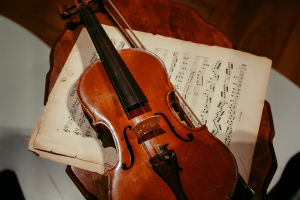
The violin, in particular, saw major developments in this period. The Stradivari family began making violins in the 17th century, creating instruments that are still considered the gold standard of craftsmanship today. These violins offered exceptional tone and projection, allowing for more expressive performances.
2. Keyboard Instruments
The harpsichord, and later the piano, emerged during the Baroque period. The harpsichord plucked strings, producing a bright sound, while the piano, invented by Bartolomeo Cristofori in the early 18th century, allowed for dynamic variation in volume—a true innovation that would change the course of music forever.
3. Brass and Woodwinds Develop
Brass instruments, such as the trumpet and horn, evolved with the addition of valves, making them capable of producing more notes. Similarly, woodwind instruments like the clarinet became more refined and complex, offering a wider range of tones.
The Industrial Revolution: Mass Production and Accessibility
With the Industrial Revolution came a surge of technological advancements that affected nearly every aspect of life—including musical instruments. These innovations allowed for mass production, making instruments more accessible to the general public.
1. Standardization of Instruments
As manufacturing processes improved, musical instruments could be standardized. No longer were instruments handmade by craftsmen alone; factories started to produce instruments more efficiently, making them more affordable and available to a wider audience. This democratization of music helped shape the music culture of the 19th and 20th centuries.
2. Invention of Electric Instruments
In the 20th century, electric instruments—such as the electric guitar and synthesizer—revolutionized music. The electric guitar, in particular, became a central element of popular music, especially rock and roll. Meanwhile, the synthesizer opened up new possibilities for creating sound through electronic means, further pushing the boundaries of music production.
The Digital Age: Synthesizing Sound and Expanding Creativity
The 21st century has seen even further evolution, this time in the form of digital instruments and computer-based music creation. Modern technology has allowed musicians to create sound with unprecedented flexibility.
1. Digital Instruments
Today, we have instruments that can generate sound entirely through digital means. Synthesizers have evolved into digital workstations, allowing musicians to produce a vast array of sounds with just a few keystrokes. Virtual instruments also allow anyone to create music, even without access to physical instruments.
2. Integration with Technology
The rise of music production software (DAWs), like Ableton and Logic, has transformed how musicians compose and perform. Digital instruments can now be fully integrated with computers and recording equipment, providing infinite possibilities for creating new and innovative sounds.
Reflections: The Endless Possibilities of Music
As we look at the evolution of musical instruments, we realize that music is always changing. Every new instrument or technological advancement opens up a world of creativity, pushing musicians to explore new ways of making sound.
The story of musical instruments is far from over. With advancements in AI, virtual reality, and wearable tech, who knows how the instruments of tomorrow will sound? One thing's for sure: music will continue to evolve, just as it always has.